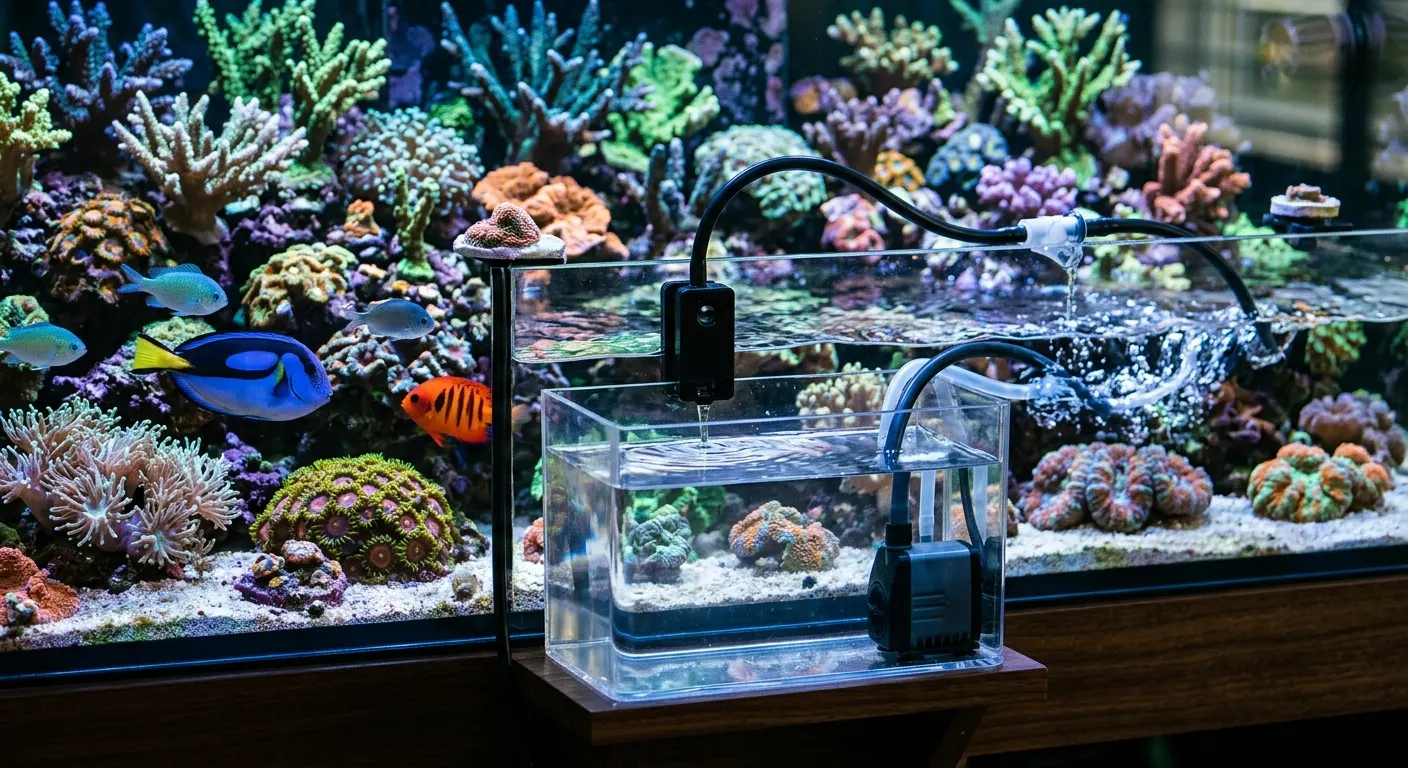
Best Auto Top-Off for a Reef Tank: Stop Salinity Swings
By ReefGrade . 9 min read . Updated June 2026
Evaporation never stops. A typical open-top reef loses a gallon or more of freshwater per day, and because only water evaporates while salt stays behind, salinity climbs steadily between manual top-offs and then drops sharply when you finally add water. That sawtooth pattern is one of the most common hidden stressors in the hobby: corals tolerate a stable 1.026 far better than a system that oscillates between 1.025 and 1.028 every few days. An auto top-off system replaces that cycle with continuous small additions that hold salinity essentially flat. It is also the equipment category where a cheap failure is most expensive, because an ATO stuck in the on position pumps its entire freshwater reservoir into your tank. This guide covers how to choose a unit whose failure modes are covered, not just one that works on day one.
Quick answer
The Tunze Osmolator 3155 is the best standalone ATO for most reef tanks: optical primary sensor, float backup, and a decades-long reliability record. Reefers in the Neptune ecosystem should choose the ATK v2 for Apex integration and alerts. Size your reservoir for about one week of evaporation and never more than 10 percent of system volume.
This guide contains affiliate links. ReefGrade may earn a commission at no cost to you.
Why salinity stability matters more than the exact number
Corals and invertebrates osmoregulate slowly. A reef held steadily at 1.024 will generally outperform one that averages 1.026 but swings half a point in each direction, because every salinity move forces tissue-level adjustment that costs energy the coral would otherwise spend on growth and color. Salinity swings also drag every other parameter with them: as water evaporates, calcium, alkalinity, magnesium, and nutrient concentrations all rise together, then dilute when you top off manually.
The math is unforgiving on small tanks. A 20-gallon nano losing half a gallon per day to evaporation concentrates its salt by roughly 2.5 percent daily. Skip two days of top-off and salinity has moved from 1.026 to past 1.027. The same evaporation on a 100-gallon system barely registers. This is why an ATO is arguably more important on a nano than on a large system, and why it should be installed before a protein skimmer on most small builds.
An ATO does not replace testing. Verify your refractometer monthly against calibration solution and confirm the system is holding your target, because an ATO holds the water level constant, not the salinity reading itself. If your level sensor drifts or your reservoir runs dry without an alarm, salinity moves and the ATO cannot tell you.
Sensor technology: optical, float, and conductivity
Float switches are the oldest approach: a magnetic float rides the water level and closes a switch at the set point. They are cheap and need no calibration, but they have moving parts that snails, asterina starfish, salt creep, and algae routinely jam. A float stuck down runs the pump continuously; a float stuck up never tops off. No serious modern ATO uses a single float as its only sensor.
Optical sensors detect the water surface with an infrared beam and have no moving parts, which removes the snail-and-salt-creep failure mode almost entirely. They can be fooled by microbubbles from a nearby skimmer or return line, so mount the sensor in a calm sump chamber. The Tunze Osmolator 3155 ATO pairs an optical primary sensor with a float switch as an independent backup and adds a 10-minute maximum pump runtime cutoff, which is the layered design you should demand from any ATO.
The Neptune ATK V2 Auto Top-Off Kit takes the same philosophy further with two optical sensors plus a float, all monitored by its own microprocessor. On its own it is a complete standalone ATO; connected to a Neptune Apex A3 Controller System via the included FMM-style link, it gains push alerts when the reservoir runs low or the pump runs longer than expected, which converts a silent failure into a phone notification.
Top picks by build type
For a standalone system with no controller, the Tunze Osmolator 3155 ATO is the default recommendation and has been for years. The metering pump is gentle enough for nano sumps, the controller logic limits maximum dosing volume, and the German build quality shows in units still running after a decade. It is the ATO to buy when you want to install it and stop thinking about it.
For Neptune households, the Neptune ATK V2 Auto Top-Off Kit is the obvious pick. The hardware redundancy matches the Tunze, and the Apex integration means your top-off events are logged and graphed alongside everything else. If you are already planning an Neptune Apex A3 Controller System or the larger A3 Pro for dosing and probe monitoring, buying the ATK at the same time costs little extra and closes the biggest stability gap first.
HYDROS users get an equivalent path: the CoralVue HYDROS Control 4 supports level sensing and pump control through its drive ports and sensor inputs, so a DIY-leaning reefer can assemble ATO logic with alerts inside the Collective ecosystem. It is more configuration work than the plug-and-play units, but it keeps everything on one app and one alert pipeline.
Reservoir sizing and fail-safe setup
Size the reservoir to hold roughly one week of evaporation, but cap it at about 10 percent of total system volume. The reasoning is the worst case: if the ATO fails on and empties the entire reservoir into the tank, a 5-gallon reservoir into a 75-gallon system drops salinity about 6 percent, which is survivable. A 20-gallon reservoir into the same system is a wipeout. A smaller reservoir you refill weekly is a feature, not an inconvenience.
Fill the reservoir with RODI water only, never saltwater, since the goal is replacing pure evaporated water. Mount the pump at the bottom of the reservoir, route the output line above the sump waterline with a siphon break hole, and place the sensors in the return chamber of the sump where the level actually moves with evaporation rather than in a skimmer chamber held constant by a baffle.
Finally, test the failure path on purpose. Once a quarter, lift the sensor out of the water and confirm the pump cutoff or alarm fires, and let the reservoir run dry once to confirm the low-reservoir behavior. An ATO you have never seen fail safely is an ATO you are trusting on faith.
Featured in this guide
Keep reading
Related comparisons
Related roundups
FAQ
Frequently asked questions
Can I use my ATO to dose kalkwasser instead of plain RODI?+
Yes, with caution. Dosing saturated kalkwasser through the ATO is a classic technique for replacing evaporation while supporting calcium and alkalinity, but it raises the stakes of a stuck-on failure because the reservoir is now high-pH limewater rather than neutral RODI. Only do this with a unit that has redundant sensors and a runtime cutoff like the Tunze Osmolator or Neptune ATK, keep the reservoir small, and confirm your evaporation rate can actually consume the kalk you are adding without driving pH past 8.5.
Where should I put the ATO sensor in a tank without a sump?+
In an all-in-one or sumpless tank, place the sensor in the rear filtration chamber where the return pump sits, because that chamber is where the water level falls as evaporation occurs while the display level stays constant. Keep the sensor away from filter floss and media bags that can wick water or trap bubbles against the sensor face, and clean the optical window during your weekly maintenance.
My ATO runs several times a day in short bursts, is that normal?+
Yes, and it is exactly what you want. Frequent small top-offs are the entire point of an ATO: each event replaces a few ounces of evaporation, so salinity never measurably moves. Be concerned about the opposite patterns: a pump that runs for minutes at a time may indicate a sensor mounted in a chamber that drains during other equipment cycles, and a pump that never runs means a stuck sensor or an empty reservoir, both worth investigating the same day.