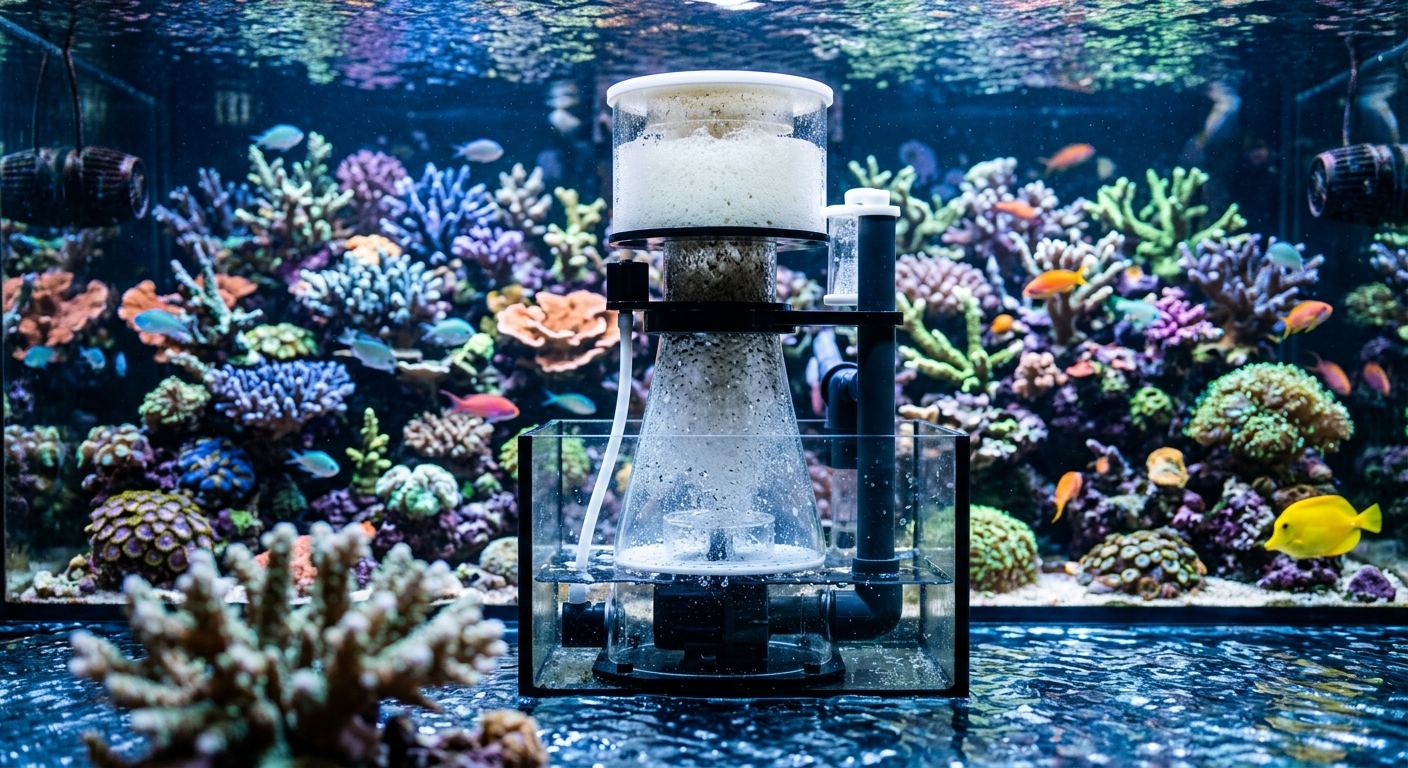
Best Protein Skimmer by Tank Size: Honest Sizing Guide for Reef Tanks
By ReefGrade . 9 min read . Updated June 2026
Protein skimmer sizing is one of the most consistently misjudged purchases in reef-keeping. The manufacturer tank-size ratings on skimmer packaging are notoriously optimistic, calibrated for lightly stocked FOWLR systems rather than coral-dense reef tanks with multiple fish. A skimmer rated for 150 gallons is the right choice for a 75-gallon reef with moderate coral density and four to six fish. Understanding why the ratings exist and how to interpret them for your actual system prevents the frustrating experience of buying an undersized skimmer and diagnosing chronic nutrient problems months later.
The short answer
Buy a skimmer rated for 1.5 to 2 times your actual tank volume. For systems under 40 gallons, a quality HOB skimmer handles the job. For 50 to 120-gallon reefs, the Reef Octopus Regal 150-INT is the benchmark. For 120-plus-gallon systems, the Nyos Quantum 160 or a larger Reef Octopus Regal handles the load.
This guide contains affiliate links. ReefGrade may earn a commission at no cost to you.
How skimmer ratings actually work
Protein skimmer tank size ratings are calculated for a low-bioload system running at approximately 0.5 to 0.8 inches of fish per gallon with minimal coral. Most established reef tanks run two to three times that bioload, which means the rated capacity needs to be divided roughly in half to get your real-world usable capacity.
A skimmer rated for 200 gallons in a reef with a 100-gallon system volume and four tangs, several damsels, and dense LPS coverage is appropriately sized. That same skimmer on a lightly stocked 50-gallon nano is overkill. The key question is not tank volume alone but bioload: how many messy fish, how much feeding, and how dense is the coral? A heavily fed, high-fish-count system of 75 gallons needs a skimmer rated for 150 to 200 gallons. A 100-gallon tank with two small fish and primarily soft coral could run a skimmer rated for 150 gallons comfortably.
Nano reefs under 40 gallons
Nano reefs under 40 gallons, particularly AIO tanks without a sump, have limited skimmer options because in-sump designs require a dedicated sump chamber. The Eshopps Nano Protein Skimmer is the practical HOB option for 20 to 40-gallon sumpless systems. It mounts on the back of the display tank, draws water from the tank, and produces functional skimmate for a lightly stocked nano reef.
Be realistic about HOB skimmer performance: it will not match in-sump skimming efficiency at equivalent price points. A nano reef running a HOB skimmer should compensate with more frequent water changes of 15 to 20 percent weekly rather than the 10 percent standard on sumped systems.
Many successful nano reef keepers skip the skimmer entirely and rely on weekly water changes, a refugium with macroalgae, and heavy live rock for biological filtration. This approach works well for lightly stocked systems with primarily soft corals, but requires discipline about the water change schedule.
Mid-size reef tanks: 50 to 120 gallons
The 75-gallon standard reef tank is the most common size in the hobby and the sweet spot for the Reef Octopus Regal 150-INT . Rated for 210 gallons, the Regal 150-INT is sized correctly for a 75 to 100-gallon reef with moderate fish stocking and mixed coral. The VarioS-2S DC pump at 15 to 25 watts allows fine-tuning of skimmate wetness, and the 11.4 by 7.5-inch footprint fits most standard sump center chambers without requiring sump modification.
If your sump is space-constrained, the Nyos Quantum 120 Protein Skimmer at a 5.1-inch footprint is the alternative. Rated for 264 gallons in the Nyos system of measurement, it is appropriately sized for a 75 to 100-gallon reef in a narrow sump chamber that the Reef Octopus does not fit. The Nyos German engineering produces consistently dry skimmate with minimal tuning, though the cleaning process is slightly more involved than the Reef Octopus.
For a 100 to 120-gallon reef with heavier stocking, stepping up to the Nyos Quantum 160 Protein Skimmer is the right move. The same compact body as the Quantum 120 but with higher pump output to handle the additional bioload from a larger fish count or denser coral.
Large reef systems: 120 gallons and above
Large reef systems with high fish bioload and dense SPS coverage demand premium skimming capacity. The Nyos Quantum 160 Protein Skimmer handles systems up to 300 gallons in manufacturer rating, making it appropriate for 150 to 200-gallon systems with normal reef stocking.
For 200-gallon and larger systems, or any system with exceptionally heavy stocking, look at the Reef Octopus Regal 200-INT or Nyos Quantum 220. These larger units are beyond the scope of most home reef builds but appropriate for display systems and serious SPS builds in the 200-plus-gallon range.
A commonly overlooked option for large systems is running two mid-size skimmers in parallel rather than one oversized unit. Two Reef Octopus Regal 150-INT units in parallel provide redundancy: if one unit malfunctions or needs cleaning, the other continues operating while you address the issue. For a reef with expensive SPS livestock, the reliability redundancy can justify the higher combined cost.
Featured in this guide
Related roundups
FAQ
Frequently asked questions
How long does it take for a new protein skimmer to break in?+
Most needle wheel in-sump skimmers take five to fourteen days to break in and produce consistent skimmate. During break-in, the impeller surfaces acquire a biofilm that improves bubble production, and the collection cup settings stabilize. During this period, expect wet, watery skimmate and possible overflow until the cup level is dialed in. Raise the water level in the skimmer body progressively over the break-in period rather than setting it high immediately.
My skimmer is producing very wet, watery skimmate, is something wrong?+
Wet skimmate during break-in is normal. After break-in, wet watery skimmate usually means the water level inside the skimmer is too high, or that something has been added to the water that is reducing surface tension, such as coral dip residue, medications, or food. Lower the water level inside the skimmer by adjusting the water outlet to reduce the body water level. If the issue persists after break-in and no additives are present, check that the pump impeller is clean and properly seated.
Can I run a protein skimmer in a freshwater aquarium?+
No. Protein skimmers require the higher surface tension of saltwater to produce and sustain the micro-bubbles that carry organic compounds to the collection cup. In freshwater, the surface tension is too low to maintain the bubble column and the skimmer produces no usable output. Protein skimming is strictly a marine filtration technology.