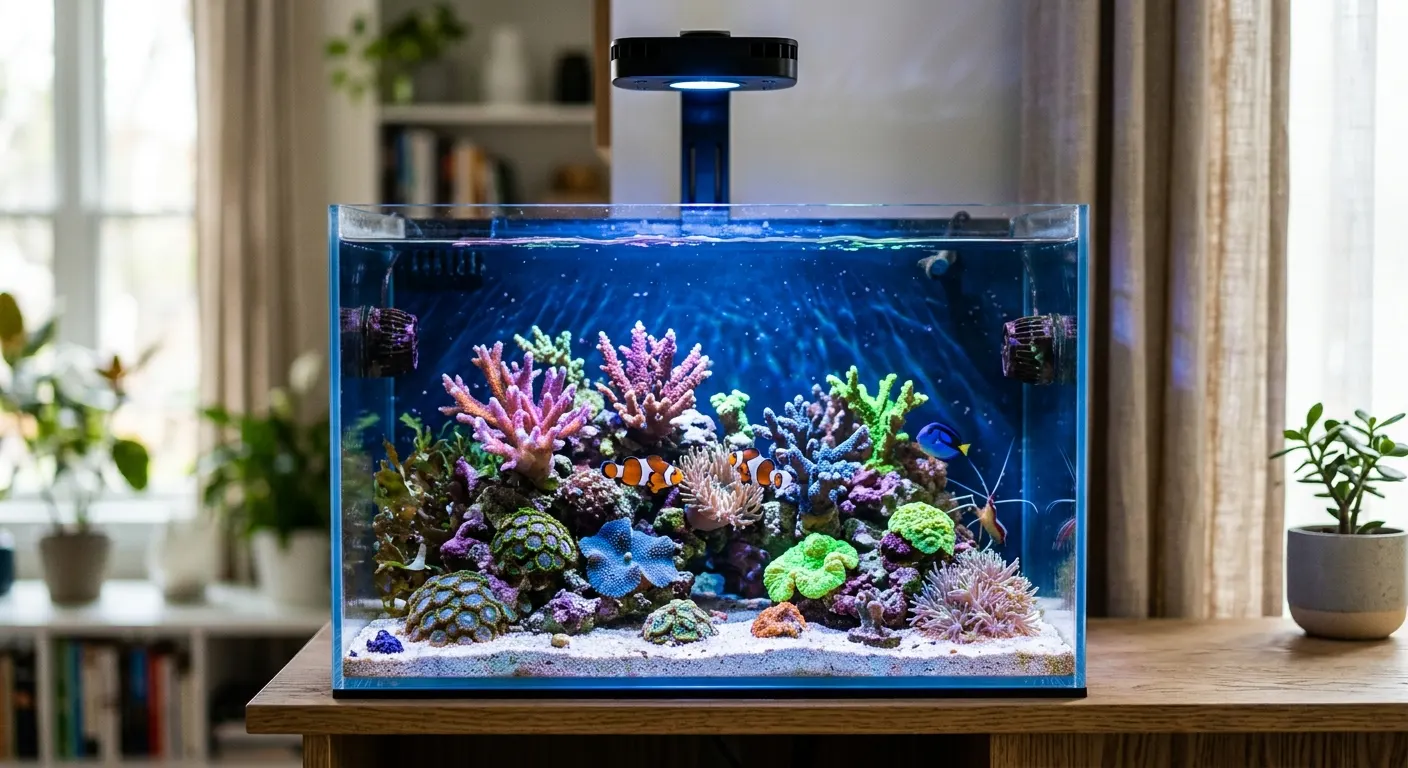
Best Reef Light for a Nano Tank: 10 to 25 Gallons Done Right
By ReefGrade . 9 min read . Updated June 2026
Nano reefs punish lighting mistakes faster than any other tank size. A fixture that is mildly oversized on a 60-gallon is a coral-bleaching spotlight on a 15-gallon cube, and the short water column means PAR at the sand bed can be double what the same fixture delivers in a standard-depth tank. At the same time, nano reefers usually want the same things large-tank owners want: enough output for LPS and a few SPS frags, a spectrum that makes corals fluoresce, and app control with a sunrise-to-sunset schedule. The good news is that the nano segment is where lighting value peaked in this generation of fixtures. This guide covers what actually matters at the 10 to 25 gallon scale and which fixtures earn a spot over these tanks.
Quick answer
The AI Prime 16HD is the best all-around nano reef light: its 16 by 16 inch SPS-capable footprint matches cube and 20-gallon dimensions almost perfectly, and the myAI app handles acclimation ramps automatically. Choose the Kessil A360X Tuna Blue for unmatched shimmer and single-point color blending. Run any fixture at 40 to 60 percent, not full power.
This guide contains affiliate links. ReefGrade may earn a commission at no cost to you.
Nano lighting math: why less is more
A typical nano is 12 to 18 inches deep, against 20 to 24 inches for standard reef tanks. Light intensity falls off rapidly with depth, so a fixture tuned for a 22-inch column delivers dramatically more PAR at 12 inches. Soft corals and most LPS thrive between 50 and 150 PAR, and even demanding SPS rarely needs more than 250 to 350 at the colony. A modern premium puck running at full output over a shallow nano can push 400 plus PAR at the rock line, which bleaches everything but the most light-hardened Acropora.
This means the buying question for a nano is not raw output, which every fixture in this guide has in excess, but spread, controllability, and how gracefully the fixture runs at partial power. A light with a smooth low-end dimming curve and a community library of nano-specific schedules will grow better corals than a stronger fixture run carelessly.
It also means budget fixtures are genuinely viable here. The output gap between an entry-level bar light and a premium puck matters on a deep 75-gallon; on a 13-inch-deep cube growing zoanthids and hammers, both exceed requirements and the premium buys spectrum quality and control rather than necessary intensity.
Best overall: AI Prime 16HD
The AquaIllumination Prime 16HD is the default nano reef light for good reason. Its rated 16 by 16 inch footprint at SPS-capable PAR maps almost exactly onto the most popular nano footprints: 20-gallon cubes, IM Nuvo 20s, and standard 10 and 15 gallon tanks. Seven color channels including UV and violet give it the fluorescence-driving spectrum of its larger Hydra siblings, and at around $250 it is the cheapest entry into the AI ecosystem.
The myAI app is the practical advantage for nano use. The built-in acclimation feature ramps intensity automatically over 30 days, and community-shared nano schedules take the guesswork out of partial-power operation. Start a new nano at 35 to 40 percent peak intensity with a 7 to 8 hour photoperiod and adjust based on coral response over weeks, not days.
For tanks at the top of the nano range, an 18 to 24 inch frag-style layout or a 25-gallon shallow, a single Prime begins to leave the corners dim. At that point the choices are two Primes or stepping up to the AquaIllumination Hydra 32HD run at low power, which adds headroom for a future tank upgrade at the cost of overkill today.
The shimmer pick: Kessil A360X Tuna Blue
The Kessil A360XE Tuna Blue takes a different approach from multi-emitter pucks: its Dense Matrix LED packs all diodes into a single point source, which produces the glitter-line shimmer of metal halide and blends color perfectly with no disco-ball spotlighting on the sand. On a rimless nano cube in a living room, the aesthetic difference is immediately visible and is the reason Kessil keeps a devoted following.
Control is simpler than AI: two knobs for intensity and spectrum on the unit, or app scheduling through the WiFi dongle. There are fewer channels to tune, which some reefers find limiting and others find liberating. Coral growth performance between an A360X and a Prime 16HD on a nano is effectively equivalent; choose between them on shimmer aesthetics and ecosystem preference, not output.
The honest budget alternative is the NICREW HyperReef E130 , which delivers reef-viable spectrum for under $100. Over a 10 to 20 gallon softie and LPS nano it is fully adequate, with the trade-offs being basic timer control instead of a schedule app, no acclimation ramp, and bar-style even lighting with zero shimmer. For a first reef where budget decides whether the tank happens at all, it is a legitimate choice you can upgrade away from later.
Mounting, schedules, and the bleaching mistake everyone makes
Mount nano fixtures 8 to 12 inches above the waterline, slightly higher than the 6 to 8 inches typical on larger tanks. The extra height widens the spread to cover the full footprint and shaves peak PAR, both of which work in your favor on a shallow tank. Gooseneck arm mounts that clamp to the rear rim are the standard solution for the Prime and the A360X, and both manufacturers sell purpose-built versions.
The most common nano lighting failure is impatience: a new fixture installed at the previous owner-photo settings, full blast over freshly introduced corals. Always start new lights and new corals low. A 30-day ramp from 30 percent to your target intensity costs nothing and prevents the slow tissue-loss spiral that gets blamed on alkalinity, pests, and everything except the light.
Run blues-heavy spectrum for the bulk of the photoperiod with white channels peaking only a few midday hours. Corals fluoresce under blue, nuisance algae prefers full-spectrum white, and a 20,000K-leaning schedule is both the best-looking and the most forgiving way to run a nano.
Featured in this guide
Keep reading
Related comparisons
Related roundups
FAQ
Frequently asked questions
Can I grow SPS corals in a nano with an AI Prime 16HD?+
Yes. The Prime 16HD produces SPS-level PAR in the center of its footprint, and the shallow water column of a nano works in your favor since even mid-rock placements receive strong light. Place Acropora and Montipora in the upper half of the rockwork under the fixture center, run peak intensity around 50 to 60 percent, and verify with a borrowed PAR meter if you are investing in expensive frags. Stability of alkalinity and salinity will limit nano SPS success long before the light does.
How long should my nano reef photoperiod be?+
Seven to nine hours of meaningful intensity is the standard range, typically with one to two hour blue-only ramps at each end. Longer photoperiods do not grow corals faster; they extend the daily window for algae photosynthesis and heat buildup in a small water volume. If you are fighting nuisance algae in a nano, shortening the photoperiod to six or seven hours and cutting white channel intensity is one of the most effective levers available.
Is one light enough for a 24 inch nano or do I need two?+
At 24 inches you are at the boundary. A single Prime 16HD or A360X centered over a 24-inch tank covers the middle 16 to 18 inches at strong PAR and the ends at soft-coral levels, which works if you aquascape demanding corals toward the center. For an even frag-style layout or SPS at the ends, two Primes spaced at one-third and two-thirds of the length is the clean solution, and it adds redundancy if one fixture ever fails.