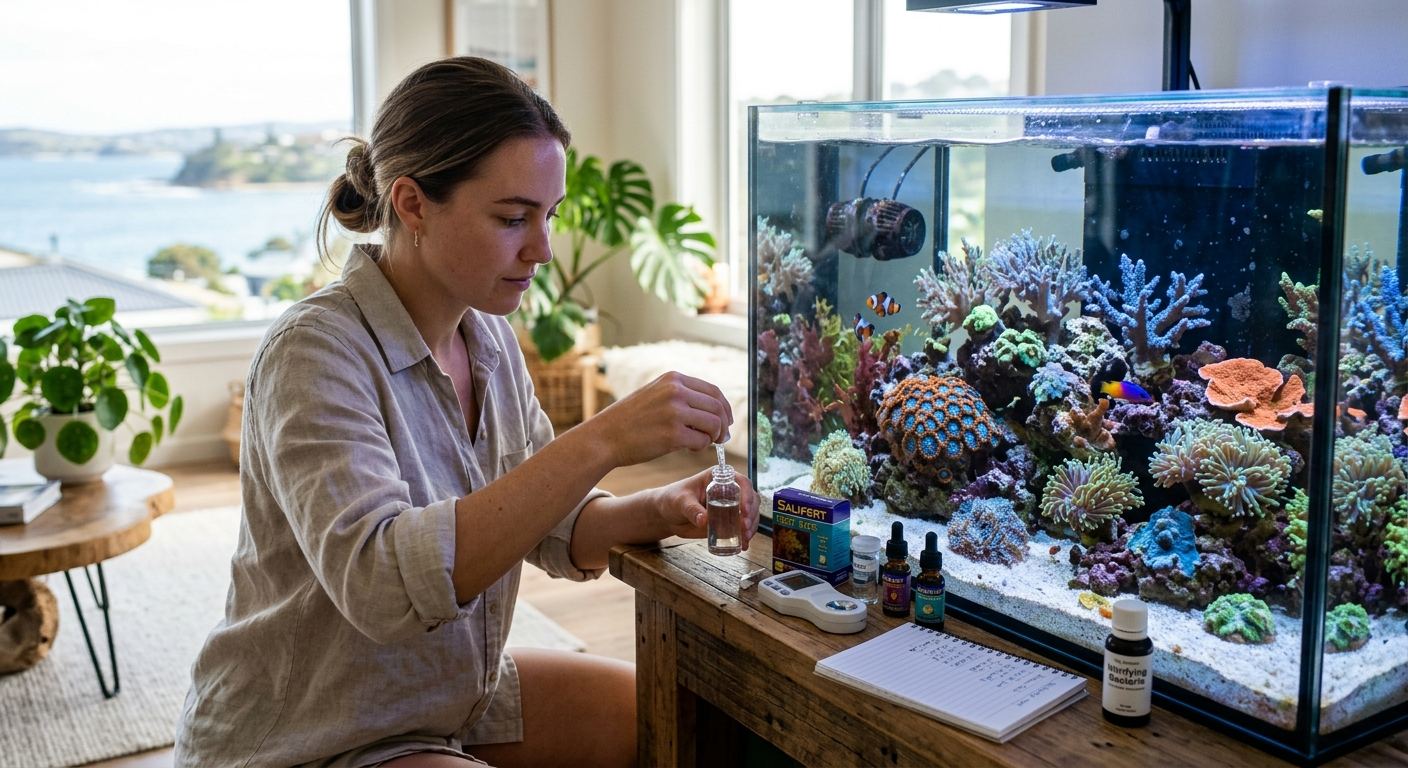
How to Cycle a New Reef Tank: The Complete Guide
By ReefGrade . 12 min read . Updated June 2026
Cycling is the single most important process in setting up a new reef tank, and it is the one step most beginner reefers rush past and then spend months paying for in ammonia spikes, dead fish, and stressed corals. A properly cycled tank has an established population of nitrifying bacteria that converts toxic ammonia to nitrite and then nitrite to nitrate. Until that bacterial population is stable, ammonia and nitrite levels in the tank are lethal to fish and highly stressful to coral. This guide walks through the complete cycle process using Dr. Tim's One and Only nitrifying bacteria, which reduces cycle time from six to eight weeks to two weeks when used correctly.
The short answer
Use Dr. Tim's One and Only Saltwater nitrifying bacteria with a fishless ammonia dosing protocol. Add bacteria day one, dose ammonia to 2 ppm, then test daily. Nitrite appears within 3 to 5 days, then drops while nitrate rises. When ammonia and nitrite both read zero within 24 hours of dosing, the cycle is complete. Total time is typically 10 to 14 days.
This guide contains affiliate links. ReefGrade may earn a commission at no cost to you.
What you need before you start
Required items for a Dr. Tim's protocol cycle: Dr. Tim's One and Only Saltwater Bacteria sized for your total system volume, pure ammonium chloride cycling solution, an ammonia test kit, a nitrite test kit, and a nitrate test kit. The Salifert Master Reef Testing Combo Kit covers all three of these plus pH, calcium, and alkalinity in one purchase, which you will need throughout the life of the tank anyway.
The quality of your test kits matters during the cycle. Salifert's ammonia, nitrite, and nitrate kits are more sensitive at the low end of the range than most API kits, which is important during the final days of the cycle when you are testing whether ammonia and nitrite are truly at zero versus merely below API detection threshold. A false zero reading can lead you to add fish before the cycle is actually complete.
Why Dr. Tim's speeds up the cycle
A tank cycling without bacterial inoculant relies on ambient Nitrosomonas and Nitrospira bacteria from the air, from live rock, and from any seeded media. This natural colonization process takes six to eight weeks because the bacteria must establish from near-zero starting populations. Dr. Tim's One and Only Saltwater Bacteria adds concentrated live Nitrosomonas and Nitrospira directly to the water column, seeding the cycle with an established bacterial population rather than waiting for ambient colonization.
Dr. Timothy Hovanec, the microbiologist who developed the product, specifically isolated the Nitrospira strains that are most effective in saltwater systems. The saltwater formula is different from the freshwater version; use the saltwater product for marine and reef applications. The 10 percent affiliate commission and 60-day cookie on Dr. Tim's via Awin make it the highest-commission product on this site. It is also genuinely the best product for the application.
Combine the Dr. Tim's inoculant with seeded live rock or media from an established reef if you have access to it. A fist-sized piece of rubble from an established sump carries millions of established bacteria that complement the bottled inoculant and can reduce cycle time to seven to ten days. If you do not have access to seeded media, the Dr. Tim's protocol alone cycles reliably in ten to fourteen days.
Common cycling mistakes
Adding fish before cycle completion is the most common and costly mistake. The signs of an incomplete cycle include any detectable nitrite, which is directly toxic to fish at concentrations above 0.5 ppm. Wait for confirmed zero on both ammonia and nitrite within 24 hours of a 2 ppm ammonia dose before any fish go in.
Running excessive flow through filter socks or mechanical filtration during the cycle can remove bacterial inoculant before it colonizes. Remove fine mechanical filtration for the first two weeks of cycling and use foam or coarse media only. Fine mechanical filtration can be re-added after the cycle is confirmed complete.
Salt choice matters even during cycling. Use the same Red Sea Coral Pro Salt or Tropic Marin Pro-Reef Salt you plan to run long-term, because switching salts after cycling introduces new parameter baselines that can temporarily stress bacterial populations.
Featured in this guide
Keep reading
Related roundups
FAQ
Frequently asked questions
Can I add coral during a fishless cycle?+
You can add hardy corals like zoanthids and mushrooms after nitrite has peaked and is dropping, typically around day 8 to 12. Avoid adding corals during the nitrite spike phase since elevated nitrite stresses coral tissue. Wait for confirmed zero on ammonia and nitrite before adding any SPS or LPS corals. Adding frags during the tail end of the cycle does not harm the bacterial colonization process and gets coral established before fish are introduced.
My nitrite has been stuck high for a week, what is wrong?+
A persistent nitrite peak usually means the nitrite-oxidizing bacteria population has not fully established yet. Continue dosing ammonia normally; do not stop. Confirm your tank temperature is at 77 to 78 degrees, since cold water significantly slows bacterial growth. Consider adding a second dose of Dr. Tim's One and Only to boost the Nitrospira population. Patience is the fix in most cases: the nitrite-oxidizing side of the cycle always lags behind the ammonia-oxidizing side, and the drop usually comes suddenly after an extended peak.
Do I need to run my protein skimmer during the cycle?+
Yes. Run all equipment normally during the cycle to confirm function and to establish normal water movement conditions. Some reefers turn the skimmer off during the first 48 hours after adding nitrifying bacteria to prevent removing the inoculant before it colonizes, but this is optional. Running the skimmer from day one does not meaningfully slow the cycle process when using Dr. Tim's protocol, since the bacterial concentration in the product is high enough that normal skimmer operation does not deplete it.