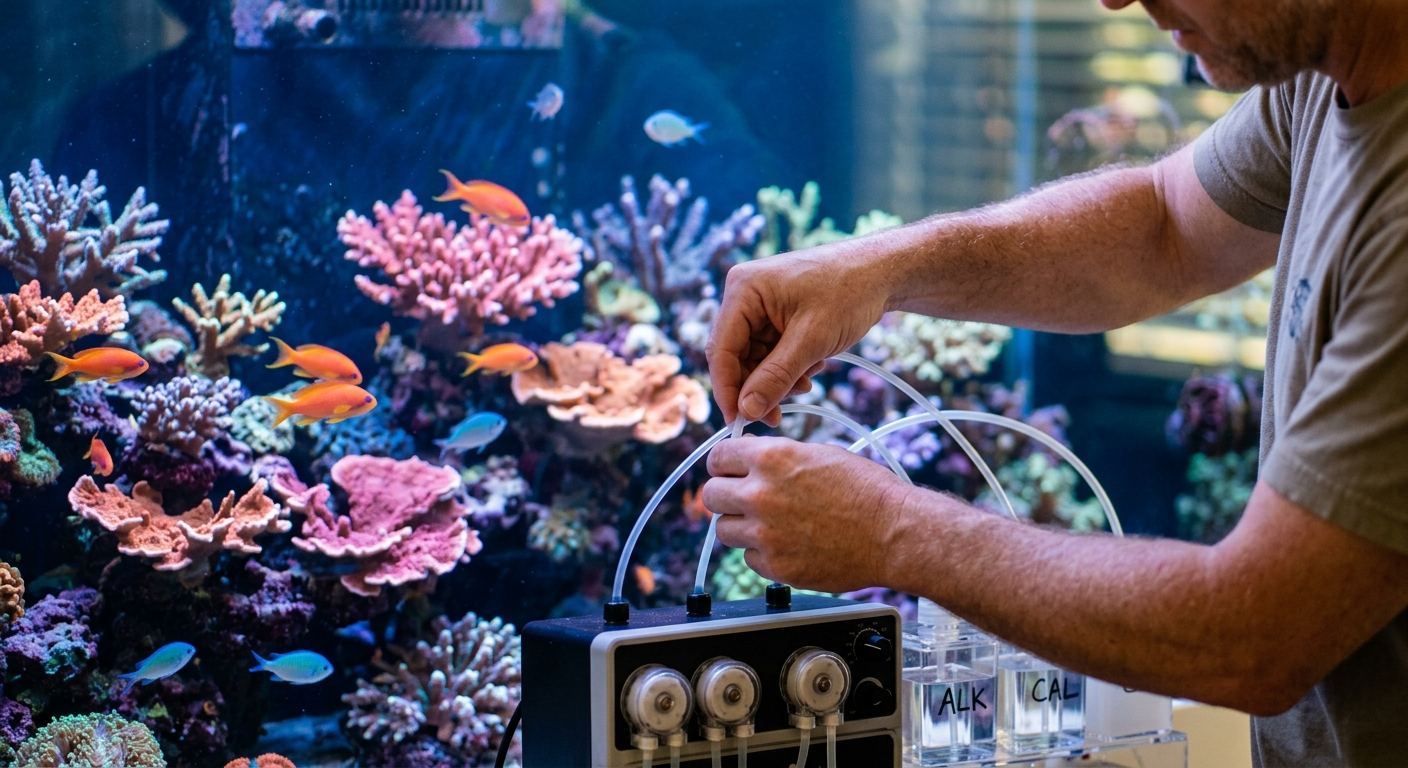
How to Set Up Two-Part Dosing for a Reef Tank
By ReefGrade . 11 min read . Updated June 2026
Every coral reef tank eventually reaches the point where water changes alone cannot keep up with the calcium and alkalinity that growing corals consume. When you start noticing alkalinity dropping between water changes even with weekly changes, it is time to start dosing. Two-part is the most practical entry point: two liquid solutions, dosed daily in equal volumes, that maintain calcium and alkalinity in the same ratio that corals consume them. This guide covers when to start dosing, how to calculate your daily dose rates, and how to set up automated delivery using a dosing pump.
The short answer
Start two-part dosing when alkalinity drops more than 0.5 dKH between weekly water changes. Test daily for three days to calculate consumption rate, then set your dosing pump to replace that volume. Use Brightwell Reef Code A and B for the best value, or Red Sea Foundation A and B for systems on Red Sea salt. Test twice weekly to confirm stability.
This guide contains affiliate links. ReefGrade may earn a commission at no cost to you.
Choosing the right two-part solution
The Brightwell Aquatics Reef Code A and B is the best value two-part liquid system for most reef tanks. At $18 to $22 per 2-liter bottle from BRS, it provides a cost-effective calcium and alkalinity solution that scales well for tanks consuming up to three liters of each part monthly. The formulation raises calcium and alkalinity in natural seawater proportions when dosed in equal amounts, which eliminates the constant recalibration that solutions with mismatched ratios require.
For tanks already using Red Sea Coral Pro Salt , the Red Sea Reef Foundation A, B, and C provides a chemistry-matched dosing system. Red Sea formulates Foundation A and B to complement their salt chemistry specifically, which simplifies the tuning process for reefers already on the Red Sea platform.
Heavy SPS systems consuming four or more liters of each part monthly should consider switching from liquid two-part to a DIY powder solution. BRS sells bulk calcium chloride and sodium bicarbonate at significantly lower cost per effective dose than pre-mixed liquid two-part. The mixing process is more involved but saves substantial money for systems with high calcium and alkalinity consumption.
Automated dosing pump setup
The Neptune DOS QuietDrive Dosing System is the premium automated dosing option for Neptune Apex users. The two-head design covers both Part A and Part B in a single unit, and native Apex Fusion integration allows dose scheduling to be built into the same programming environment as your other equipment. The QuietDrive motor runs nearly silently and does not create audible pump cycles that interrupt a quiet living room environment.
For reefers not in the Neptune ecosystem, a standalone peristaltic dosing pump with two heads handles two-part delivery reliably. Budget options in the $40 to $80 range from Kamoer and Jecod lack Apex integration but deliver accurate volumes on programmable schedules. They require more manual calibration but function reliably for basic two-part delivery.
Position your Part A and Part B containers at the same height relative to the dosing pump, and ensure the tubing runs to different areas of the sump. Never dose Part A and Part B through the same tubing or into the same area simultaneously; the concentrated solutions react when undiluted and can form a white precipitate that clogs tubing and temporarily raises turbidity.
Testing while dosing
The Hanna HI772 Alkalinity Checker (dKH) is the essential testing tool for any reefer running two-part dosing. The precision to 0.1 dKH that the HI772 provides is necessary for calibrating dose rates accurately. Visual titration kits with 0.5 dKH resolution are adequate for monitoring an established tank but insufficient for the fine-grained dose adjustment that setting up a new dosing program requires.
Test at the same time of day every time, ideally before the lights come on in the morning. Alkalinity has a diel cycle driven by photosynthesis: it is highest in the early morning and lowest in the late evening. Testing at different times of day produces results that appear to show parameter swings that are actually normal daily biological variation. A consistent testing time eliminates this variable.
The Salifert Master Reef Testing Combo Kit provides calcium and magnesium testing alongside alkalinity to confirm that your two-part is maintaining all three major parameters together. Calcium and alkalinity are consumed in a fixed ratio during coral calcification, and monitoring both together confirms your Part A and Part B doses are balanced correctly.
Featured in this guide
Keep reading
Related roundups
FAQ
Frequently asked questions
Can I add two-part solutions directly to the display tank?+
Yes, but dose into high-flow areas and in small divided amounts rather than large single additions. The safest approach is to add to the sump return section where the return pump immediately dilutes the solution into the full system volume before it reaches the display. Never dose concentrated solutions directly onto corals or into a low-flow dead zone.
Two-part versus kalkwasser: which should I use?+
Kalkwasser raises alkalinity and calcium simultaneously while also precipitating phosphate and raising pH, making it an elegant solution for lightly to moderately stocked systems. The limitation is that kalkwasser must be dosed slowly in the top-off water to avoid pH spikes, and heavy coral consumption can outpace what kalkwasser can safely deliver. Two-part scales with consumption without the pH sensitivity issue. Most advanced reefers start with kalkwasser in the ATO reservoir and add two-part when coral consumption exceeds what kalkwasser alone covers.
My alkalinity is stable but my pH is dropping, is something wrong?+
Falling pH with stable alkalinity is usually a CO2 accumulation issue in the room, not a water chemistry problem. Homes with poor ventilation, especially in winter with windows sealed, have elevated atmospheric CO2 that the tank water absorbs. The fix is improving gas exchange: direct your skimmer air intake outside using tubing, or simply open a window near the tank during the day. Running a calcium reactor also lowers pH through CO2 injection, so calcium reactor users often supplement with a kalkwasser drip to offset pH depression.