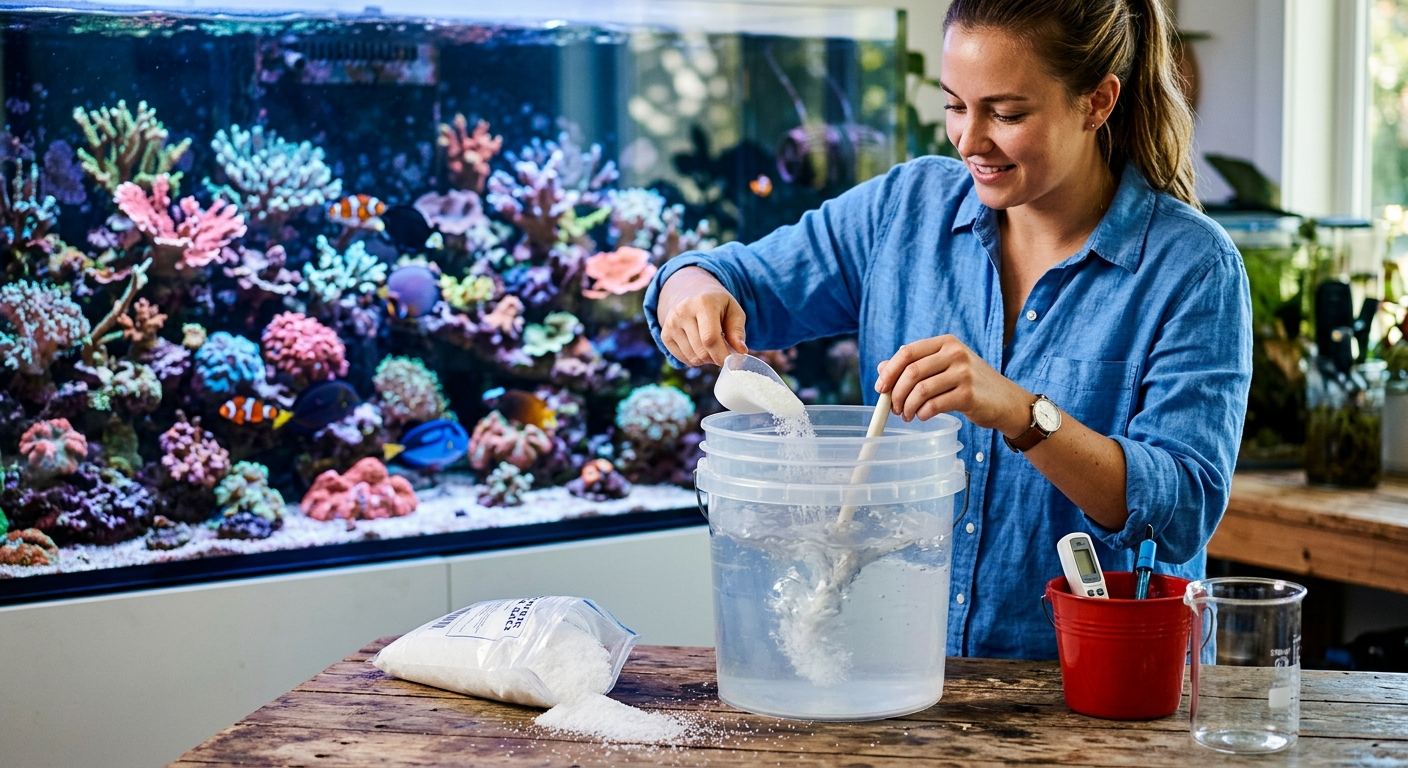
How to Mix Saltwater for a Reef Tank: Step-by-Step
By ReefGrade . 8 min read . Updated June 2026
Mixing saltwater incorrectly is one of the most common beginner mistakes in reef-keeping, and the damage it causes, which includes coral stress from sudden salinity shifts and parameter spikes from incompletely dissolved salt, is entirely avoidable. The process is straightforward when you follow the right sequence. This guide covers the equipment you need, the exact steps for mixing a batch of reef saltwater, how to test the result before adding it to your system, and the storage practices that maintain quality between water changes.
The short answer
Mix RODI water first, then add salt gradually with a circulation pump running. Let it mix for a minimum of 12 hours before testing. Target specific gravity of 1.025 to 1.026 and verify alkalinity, calcium, and magnesium before using. Never add salt directly to your display tank.
This guide contains affiliate links. ReefGrade may earn a commission at no cost to you.
Equipment you need before you start
Before mixing your first batch of reef saltwater, you need: an RODI water unit or a source of zero-TDS water, a dedicated mixing container (a 20-gallon Brute trash can works well and is food-safe), a small circulation pump to keep water moving, a heater, a calibrated refractometer, and your salt mix.
Your salt mix choice determines the baseline chemistry of every water change. For a reef tank housing corals, use a dedicated reef salt rather than a standard marine salt. The Red Sea Coral Pro Salt is the most widely used option for SPS and mixed reef tanks: elevated calcium, alkalinity, and magnesium mean every water change actively supports coral calcification. For a budget FOWLR or soft coral system, the Instant Ocean Reef Crystals provides reliable baseline chemistry at roughly half the cost per gallon.
A reliable refractometer is non-negotiable. Swing-arm hydrometers introduce error from trapped air bubbles and are inaccurate enough to cause real problems in a reef system. A quality refractometer calibrated with standard seawater solution is the minimum instrument for measuring salinity accurately.
Testing your mixed water before use
Salinity verification with a refractometer is the minimum check before every water change. For a mixed reef or SPS system, also verify alkalinity, calcium, and magnesium to confirm the batch is within your target range before adding it in volume to an established system.
The Hanna HI772 Alkalinity Checker (dKH) is the most practical alkalinity test for this purpose. A two-minute test with a digital readout to 0.1 dKH precision confirms whether your batch is alkalinity-normal before use. Batch-to-batch variation in reef salts is rare but not unheard of, and catching a high-alkalinity batch before it goes in the tank is far better than diagnosing a parameter spike after the fact.
For a complete batch quality check, the Salifert Master Reef Testing Combo Kit covers all six essential parameters. Testing a fresh batch once every few weeks confirms your salt is performing consistently and identifies any batch variation before it reaches your corals.
Common mistakes and how to avoid them
Adding salt directly to the display tank is the mistake that causes the most immediate coral damage. Undissolved salt crystals landing directly on corals cause osmotic stress burns that kill tissue in hours. Always pre-mix in a separate container.
Adding cold saltwater during a water change creates a temperature shock that stresses fish and corals. Heat your new saltwater to match your tank temperature before the water change, not after it is already in the tank.
Using a refractometer that has not been calibrated against standard seawater solution produces readings that are systematically off. Calibrate your refractometer monthly with calibration solution, not freshwater. A refractometer calibrated with RODI water reads approximately 0.001 to 0.002 specific gravity higher than accurate, which translates to actual salinity being lower than displayed.
Featured in this guide
Keep reading
Related roundups
FAQ
Frequently asked questions
Can I use a saltwater mix immediately after dissolving it?+
No. Salt needs at minimum 12 hours of circulation at aquarium temperature to fully dissolve and for parameters to equilibrate before you test accurately. Red Sea Coral Pro Salt and Tropic Marin Pro-Reef both recommend 24 hours for best results. Using water that has mixed for only 30 minutes introduces undissolved components and produces inaccurate test readings that may lead you to over- or under-dose adjustments.
What is the correct salinity for a reef tank?+
Natural seawater runs 1.025 to 1.026 specific gravity, and that is the standard target for reef tanks. Many SPS reefers run exactly 1.026. The most important thing is stability, not the exact number: a reef at 1.024 that never varies is better than a reef targeting 1.026 that fluctuates between 1.023 and 1.028. An auto top-off system is the most reliable way to maintain stable salinity between water changes.
How much salt mix do I need for a 75-gallon tank?+
A 75-gallon display tank with a 20-gallon sump runs approximately 80 to 90 gallons of system water. At 10 percent weekly water changes, you replace about 8 to 9 gallons per week, or 32 to 36 gallons per month. A 175-gallon bucket of Red Sea Coral Pro Salt covers roughly five weeks at that schedule. Budget approximately one bucket per month for a 75-gallon system with a 10 percent weekly change routine.